Disclaimer: I am not a financial advisor, the info on this site is for educational purposes. All investing decisions should be based on your own research. Opinions expressed here are my personal views and should not be taken as financial advice.
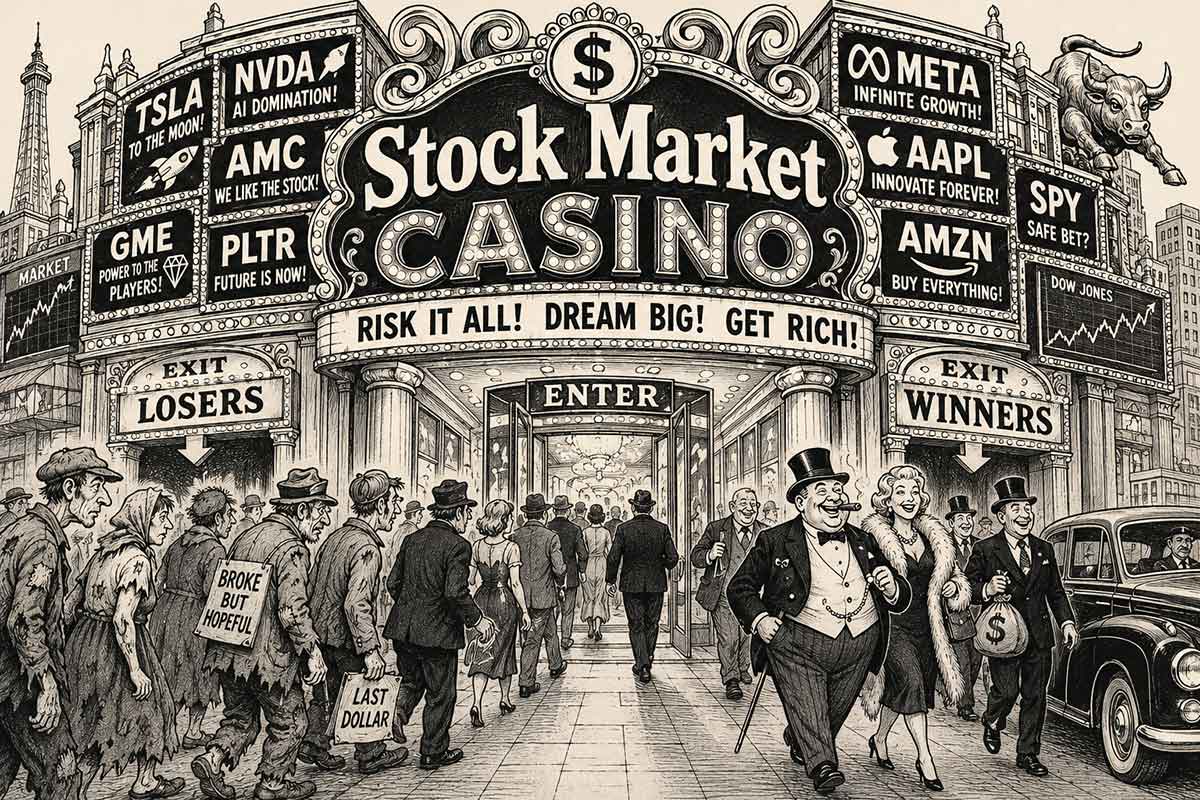
Ask ten people whether the stock market is just a big casino and you’ll probably get several different answers. Some people see investors chasing hot stocks, making risky bets, and trying to get rich overnight. From that perspective, the comparison seems fair.
Others see the market very differently. They use it to build retirement savings, invest in businesses, and grow wealth over decades. To them, comparing long-term investing to gambling makes about as much sense as comparing home ownership to buying lottery tickets.
I think both sides are seeing part of the picture. The stock market can absolutely become a casino if you treat it like one. But it does not have to be. In many ways, the stock market becomes what you make of it.
Article highlights
- The stock market can feel like gambling when people chase quick profits
- Long-term investing is very different from short-term speculation
- The same market can be used like a casino or as a wealth-building tool
Why some people think the stock market is a casino
It is easy to understand why many people compare the stock market to gambling. Stock prices move up and down every trading day, and nobody knows exactly what will happen tomorrow. Even professional investors, analysts, and economists get predictions wrong all the time.
From the outside, it can look like people are simply placing bets. One person buys a stock and makes thousands of dollars. Another person buys the same stock later and loses money. The outcome can appear random, especially when prices move for reasons that are not obvious.
Financial media adds to this feeling. Every day there are bold predictions, urgent headlines, analyst upgrades, analyst downgrades, and endless opinions about where the market is headed next. Much of it sounds confident in the moment, even though no one truly knows the future.
Social media has made the casino comparison even easier to understand. People constantly post about hot stocks, massive gains, risky trades, and the next company that is supposedly going to explode. When investing is presented like a fast-money game, it naturally starts to look like gambling.
Why they are not completely wrong
The people who call the stock market a casino are not always being unfair. There is plenty of behavior in the market that looks exactly like gambling. Even the famous Warren Buffet recently said that the markets have never looked more casino-like than they do today.
Buying a stock because a stranger online said it was going to the moon is not investing in any meaningful sense. Trading options without understanding the risk is not a long-term wealth plan. Putting money you need for bills into a speculative stock is not responsible investing.
Some investors are not thinking about businesses, profits, debt, cash flow, valuation, or long-term growth. They are simply trying to guess which price will go up next. That is where the stock market starts to look much more like a casino.
Common examples include:
- Chasing meme stocks after they already ran up
- Trading options with money you cannot afford to lose
- Buying stocks based only on social media hype
- Trying to double your money in a few days or weeks
- Constantly jumping from one hot trend to another
In those situations, the brokerage account is just the tool. The mindset is the real problem.
Why some people strongly disagree with the notion
The other side has a strong argument too. The stock market is not just a random betting system. When you buy a stock, you are buying ownership in a real business. That business may sell products, provide services, employ workers, own assets, generate profits, and grow over time.
That is very different from spinning a roulette wheel. A casino game does not produce anything. A slot machine does not build houses, sell software, ship products, or pay dividends. Public companies can do all of those things.
This is why so many retirement accounts are tied to the stock market. Millions of people use 401(k)s, IRAs, pensions, brokerage accounts, and index funds to build wealth over long periods of time. Most of them are not trying to win a quick bet. They are trying to grow their money slowly through ownership of productive assets.
That does not mean investing is risk-free. Stocks can fall, companies can fail, and entire markets can go through long rough periods. But risk by itself does not make something gambling. Starting a business is risky too, but most people would not call every business owner a gambler.
The difference is how you use it
This is where the whole debate starts to make more sense. People are often using the same words to describe completely different activities.
Someone buying weekly call options on a stock they barely understand is doing something very different from someone contributing to an S&P 500 index fund every month for 30 years. Both people are participating in the stock market, but they are not playing the same game.
For me, I use the stock market as a long-term wealth-building tool. I am not trying to hit one lucky trade and cash out. I want my money invested in assets that can grow over time, especially for retirement and future financial independence.
That does not mean I never buy individual stocks or take risks. But the overall goal is not entertainment. The goal is to put money to work in a way that gives it a chance to grow over many years.
The stock market has been around for over 230 years
The New York Stock Exchange traces its roots back to 1792, which means organized stock trading in the United States has existed for more than 230 years.
During that time, investors have been through wars, recessions, depressions, banking crises, inflation, political turmoil, housing crashes, and major market collapses. There have been many periods where owning stocks felt scary, frustrating, or even foolish.
Yet over long periods of time, the stock market has remained one of the main ways people build wealth. That is not because every year is good. It is because businesses continue creating products, providing services, earning profits, and expanding over time.
This is why the stock market has been a useful place for long-term investors to grow retirement savings. It can be very unstable in the short term, but over long stretches of time it has historically rewarded patient investors who stay diversified.
Why today’s market feels more like a casino to some people
Even if you believe in long-term investing, it is fair to admit that today’s market can feel strange at times. There is a constant pumping of the stock market now that can make everything feel more speculative.
Financial media, social media, trading apps, influencers, and even regular investors all seem to feed into the idea that the market should keep going up. Every dip becomes a buying opportunity. Every hot trend becomes the next life-changing investment. Every new technology cycle gets treated like the beginning of another massive bull market.
I understand why that makes people skeptical. When every pullback gets bought quickly and every exciting theme attracts a flood of money, the market can start to feel less grounded. It can feel like everyone is cheering for prices to go higher without asking enough questions.
That does not mean the market is fake or doomed. But it does mean investors should be careful. When optimism becomes too easy, risk usually gets ignored.
The problem with expecting endless bull markets
Bull markets are great while they last, but they can create unrealistic expectations. When stocks rise for years, people start to believe strong returns are normal every year. They may forget that long-term averages include plenty of bad periods too.
Historical stock market returns are not built only from good years. They include bear markets, crashes, flat periods, recessions, and years where investors saw little or no progress. Those weaker periods bring long-term returns down to a more reasonable average.
This matters because many newer investors have mostly experienced markets that recover quickly. That can create the belief that every decline is temporary, every dip should be bought, and every risky stock will eventually come back.
That is dangerous thinking. Some stocks do not come back. Some trends fade. Some companies never live up to the hype. A bull market can make almost everyone feel smart for a while, but that does not mean every decision was a good one.
Why bear markets are normal
Bear markets are painful, but they are a normal part of investing. They remind people that stocks carry real risk. They reset valuations when prices get too high and remove some of the speculation that builds up during long bull markets.
They can also create better opportunities for patient investors. When prices fall, long-term investors may be able to buy quality companies or broad index funds at lower prices. That does not make bear markets fun, but it does make them part of how the system works.
A market that only goes up forever would eventually become detached from reality. Prices would keep rising whether businesses deserved those prices or not. At some point, that kind of market becomes more dangerous, not less.
For people treating the market like a casino, bear markets can be devastating. For long-term investors, they are uncomfortable but expected.
A casino has a house edge
One of the biggest differences between a casino and the stock market is the house edge.
In a casino, the games are designed to favor the house. A player may win in the short term, but over time the odds are usually working against them. That is how casinos stay in business.
The stock market is different. Long-term investors are buying ownership in businesses that can grow, earn profits, and increase in value. There are no guarantees, but the basic structure is not the same as a game designed to slowly take money from players.
This is why time horizon matters so much. A person trying to predict tomorrow’s price movement may be taking a gamble. A person investing consistently for decades is relying on business growth, compounding, and ownership.
How to keep the stock market from becoming a casino
The best way to keep the stock market from becoming a casino is to avoid casino-like behavior. That means having a plan before you invest and knowing why you are buying what you are buying.
It also means being honest about risk. If you are buying one risky stock because you hope it doubles quickly, call it what it is. That may be speculation, not investing.
A more stable approach usually includes diversification, patience, and consistency. For many people, that means using index funds, contributing regularly, and keeping individual stock picks to a reasonable portion of their portfolio.
Investing does not need to be exciting to work. In fact, if it feels too exciting, that may be a sign you are drifting closer to gambling than investing.
So is the stock market just a big casino?
The stock market is not automatically a casino. But it can become one if you treat it like one.
Someone chasing hype, trading constantly, and trying to get rich quickly may have an experience that looks a lot like gambling. They are focused on short-term outcomes, emotion, and timing.
Someone investing steadily over decades is doing something very different. They are buying ownership in businesses, spreading risk, and giving their money time to grow.
That is why two people can look at the same market and see completely different things. One person sees a casino. Another sees a retirement tool. In many cases, both are describing their own behavior more than the market itself.
The bottom line
The stock market can feel like a casino, and for some people it basically becomes one. That usually happens when investors chase quick money, take oversized risks, or treat stocks like lottery tickets.
But that is a personal choice. You do not have to use the market that way. I choose to use the stock market in a safer manner, and accumulate reasonable returns over a longer period of time.
If you approach the stock market with patience, diversification, and a long-term plan, it becomes something very different. It becomes a way to grow retirement savings, build wealth, and own pieces of real businesses over time.
In the end, the stock market isn’t actually just a big casino, though there are arguments to be made that it often looks like one. Just remember, if you walk into it acting like a gambler, it can absolutely become one.
💡 Explore our free financial tools:
- Salary increase calculator – see how a raise will impact your paycheck or annual income.
- Compound interest calculator – see how small investments grow over time.
- Debt payoff calculator – find out how long it takes to pay off your debt and what it’ll cost you.
- Subscription savings calculator – uncover the true cost of forgotten subscriptions.
- Student loan payoff calculator – plan student debt payments that fit your budget.
- Retirement investment calculator – check if your savings plan supports your retirement goals.
- Emergency fund calculator – learn how much cash to keep aside for peace of mind.
- Impulse buy calculator – double-check if those purchases are really worth it.
- Mortgage refinance calculator – see how refinancing could lower payments or save interest.
- Mortgage affordability calculator – find out how much house you can afford with your budget.